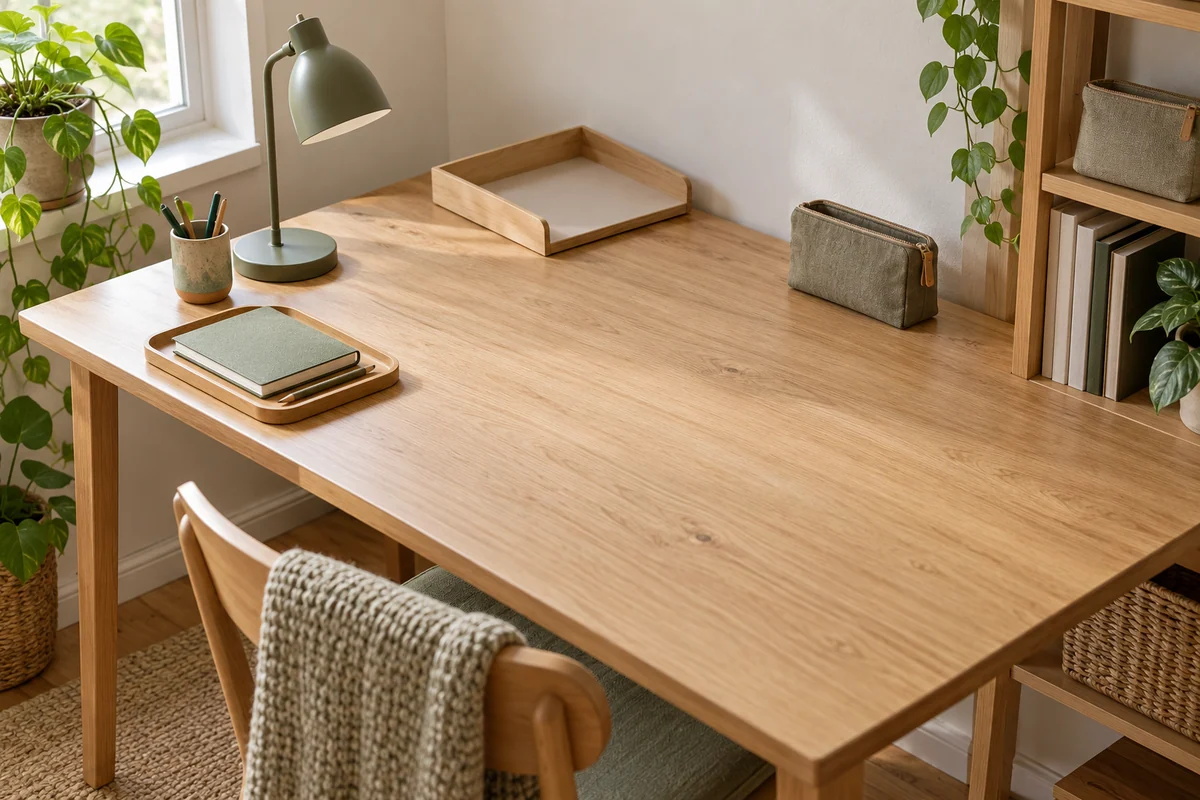
A shared desk becomes difficult when “finished” means different things to different users. One person may leave a notebook open to remember a task, while another needs the whole surface. Define a common starting state and give unfinished personal work somewhere to go.
Inventory only the things that need to live at the desk. Distinguish common supplies from personal materials and fixed equipment. A reset does not require moving connected equipment or handling someone else's private papers.
Match the plan to the usable surface
| Illustrative desk | Common zone | Personal zone during use | Handoff location |
|---|---|---|---|
| 80 × 50 cm | Small rear tray | Central working area | One labeled portable tray beside desk |
| 120 × 60 cm | Rear supply strip | Left or right working area by agreement | Two named trays outside the central space |
These are proposed zones, not ergonomic or equipment-clearance recommendations. Account separately for the actual device, its instructions and the room needed to work comfortably. If the measured equipment leaves no usable central area, reduce the desk's role rather than pretending the diagram solves it.
Write the shared starting state
Describe what the next person should see: clear central surface, common pen in its tray, personal pages in the owner's tray and a short note if something needs attention. A reference sketch can show those locations without containing personal information.
For a hypothetical two-user desk, one person ends a craft-planning session with a pattern, a ruler and three notes. The ruler returns to the common zone; pattern and notes go into the personal tray with a next-action card. The next person gets the agreed surface while the unfinished task remains understandable.
Use a five-point handoff
- Put shared supplies in their named positions.
- Move your own loose work into your assigned tray.
- Write the next action if the task is unfinished.
- Check that the agreed working area is clear.
- Leave a factual handoff note for any unresolved shared issue.
Avoid a vague “clean up” label that makes each person interpret the whole routine. Do not clear another person's tray without an agreement about ownership.
Adjust the routine when it fails
If personal trays accumulate beside the desk, choose a review event or move longer-term projects to a recorded storage place. If the common zone keeps expanding, identify which items are actually shared and move occasional supplies out. The desk should be a reliable starting surface, while the storage record preserves what cannot remain there between sessions.