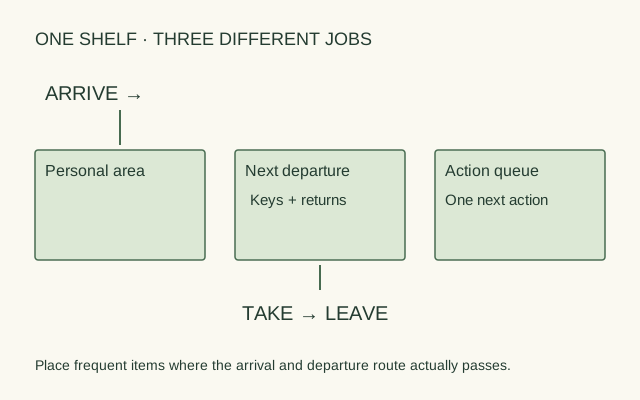
An entry shelf serves movement rather than a complete category. Keys need to leave with someone, a bag needs a reachable parking place, and a letter may need an action later. Combining all three into one heap makes the smallest objects disappear. Give each type a role along the arrival and departure route.
First list what normally crosses the doorway. Limit the plan to items that genuinely pause there. A seasonal collection belongs elsewhere unless it is part of the current routine. Measure the shelf and the largest arriving item before splitting its width.
Make three zones with different jobs
Use an arrive zone for the item you put down immediately, a leave zone for things needed on the next trip, and a narrow action queue for things that need a decision. The queue is not an archive. Label it with an action such as “reply” or “return,” rather than “miscellaneous.”
| Illustrative shelf | Arrive | Leave | Action queue |
|---|---|---|---|
| 60 cm, one user | 30 cm for a small bag | 20 cm key tray | 10 cm upright paper holder |
| 90 cm, two users | Two 30 cm personal areas | 20 cm shared departure tray | 10 cm queue |
| 60 cm, bulky bag | 40 cm bag footprint | 15 cm personal tray | 5 cm marker for one action envelope |
These widths total the nominal shelf width before divider thickness or edge clearances. Measure the actual trays and reduce allocations when hardware occupies space. If the bag does not fit the shelf depth, this particular shelf cannot serve as its parking place.
Follow one item in each direction
For a hypothetical arrival, place keys in the personal tray and an outgoing return receipt in the departure queue. The next morning, take keys and the return together. A shared shelf needs clear personal ownership so one person does not clear another's active items as clutter.
Trace the route with arrows on a paper sketch: doorway → personal area → next action → doorway. Avoid locating the small tray behind the bag. Retrieval should not require lifting the largest object first.
Reset the queue at a useful event
Choose a repeatable event, such as preparing for the next trip, and check the action queue then. Move reference papers to their actual record location, return borrowed belongings to a departure place, and remove items that have finished their doorway role. If the queue repeatedly overflows, reduce the number of things allowed to wait or move that task elsewhere. A larger queue can conceal the same unresolved decisions.
ORIGINAL REFERENCE DIAGRAM