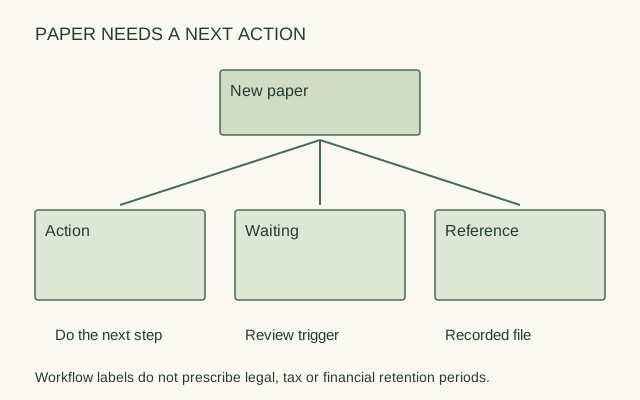
A paper inbox becomes a permanent stack when its label describes where paper arrived rather than what should happen next. Keep the inbox as a short decision point. After reading enough to identify the task, move each piece to an action, waiting or reference location.
This method organizes workflow. It does not prescribe legal, tax, medical or financial retention periods, nor does it establish whether an original document may be discarded. Follow the applicable authoritative requirements for those decisions.
Give every active piece a next action
| Example paper | State | Specific next action | Review event |
|---|---|---|---|
| Invitation needing a reply | Action | Check calendar and reply | Next planning session |
| Repair inquiry already sent | Waiting | Look for provider response | Chosen follow-up date |
| Appliance instruction sheet | Reference | File under exact model | After identification |
| Paper whose purpose is unclear | Action | Identify sender and requirement | Next inbox review |
These are hypothetical examples. Keep personal details off a shared front-facing label. A neutral ID and a private record may be more appropriate for sensitive papers.
Make three places, not three new piles
The action area contains papers with an identified next step. The waiting area contains items for which someone else or an event must act first, with a review date or trigger. Reference material goes to its actual filing location rather than staying in a third tray indefinitely.
For example, once an inquiry has been sent, move its supporting paper from Action to Waiting and write the sent date and expected follow-up. If it remains in Action, the next review may trigger a duplicate message. When the response arrives, decide the new action and update the record.
Keep the initial inbox small
At a chosen routine event, process each new piece just far enough to assign its next step. Do not require yourself to complete every large task during sorting. A document can move to Action with a clear task even when that task takes longer.
If a paper cannot be identified, preserve it in a marked pending-check group with a concrete inquiry. Do not discard it solely because it does not fit the categories.
Close the loop
Review Waiting separately from Action so completed or overdue items become visible. Move finished reference papers to the recorded file and apply appropriate retention guidance outside this workflow. If a tray overflows, find the recurring unresolved action rather than adding another identical tray. The system works when a person can tell what happens next without rereading the entire stack.
ORIGINAL REFERENCE DIAGRAM