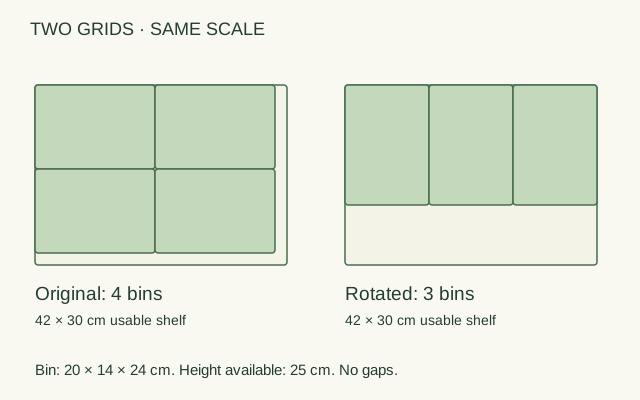
Four boxes fitting on paper is useful only if the paper calculation matches the dimensions you plan to use. This example walks through a single layer of identical rectangular bins. Every dimension is hypothetical. It compares two regular arrangements with all bins facing the same way; mixed orientations and stacking are outside the comparison.
Assume usable shelf space of 42 cm wide, 30 cm deep and 25 cm high. Each bin is 20 cm wide, 14 cm deep and 24 cm high, including its lid. Begin with no edge reservations and no gaps. These are arithmetic inputs, not a recommendation to use zero handling clearance in your cabinet.
Compare both floor orientations
In the original orientation, two 20 cm widths use 40 cm and two 14 cm depths use 28 cm. The layout holds 2 × 2 = 4 bins, leaving a 2 cm strip in each floor direction and 1 cm above the bin. A 90-degree rotation changes the footprint to 14 × 20 cm. Three fit across, one fits deep, giving 3 bins. The rotated layout uses 42 × 20 cm.
| Arrangement | Across | Deep | Total | Used footprint | Unused width / depth |
|---|---|---|---|---|---|
| Original 20 × 14 | 2 | 2 | 4 | 40 × 28 cm | 2 / 2 cm |
| Rotated 14 × 20 | 3 | 1 | 3 | 42 × 20 cm | 0 / 10 cm |
The larger count is four among these two checked grids. It is not a proof of the global best packing solution. Also, the unused strips are not an extra rectangular place to put a fifth bin: a bin must fit both dimensions of an available region.
A gap can remove a whole row
Now require a 3 cm gap between adjacent bins. In the original orientation, two widths need 20 + 3 + 20 = 43 cm, exceeding 42. Only one fits across. Two depths need 14 + 3 + 14 = 31 cm, exceeding 30. Only one fits deep. The original grid falls from four bins to one.
For the rotated grid, two widths need 14 + 3 + 14 = 31 cm, so two fit across; three need 48 cm and fail. One fits deep. The rotated grid now holds two, more than the original. The preferred checked orientation changed because the gap was applied consistently.
Height can reject every footprint
Return to zero gaps and reserve 2 cm above the boxes. Usable height becomes 23 cm. The 24 cm bin fails in both orientations, even though the floor calculation still suggests places for it. Rotating on the floor does not change the upright height.
Record internal dimensions, outside bin dimensions, every reservation and the chosen gap with the printed result. If no boxes fit, occupied footprint is zero; the diagram must not show imaginary bins or negative occupied space. Use the calculator to change one assumption at a time, then verify the entry opening and removal motion with a real stand-in.
ORIGINAL REFERENCE DIAGRAM