A shelf filled with broad towels can hide small washcloths behind or beneath them. The problem is often visibility rather than total capacity. Plan around both the folded footprint and the way a person removes a piece.
Measure one folded example of each towel size in the fold you intend to keep. Treat the measurements as your own inputs, not standard dimensions. Thickness changes with the actual textile and fold, so a stack-height estimate should be checked against the real stack.
Give each size a visible face
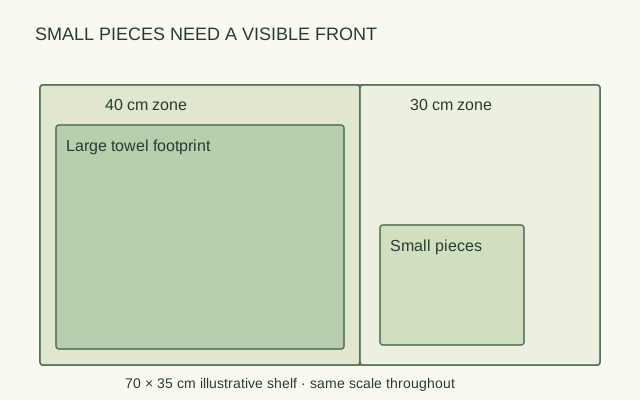
On an illustrative 70 × 35 cm shelf, allocate 40 cm of width to larger towels and 30 cm to small pieces. A large folded towel measuring 36 × 28 cm can occupy the first zone. Small towels measuring 18 × 15 cm may fit in a shallow front-facing tray in the second. Include the tray's outside dimensions and any gripping space.
| Arrangement | Useful when | Main inconvenience |
|---|---|---|
| Short separate stacks | Sizes and colors are easy to distinguish | Lower pieces require lifting the top |
| Shallow open tray for small pieces | Small items otherwise disappear | Tray wall can hide contents if too tall |
| Large stack with small stack in front | Depth allows a clear rear retrieval | Front stack may need to move |
The diagram leaves space around the groups deliberately. It is a hypothetical access layout, not a claim about moisture, antimicrobial performance or shelf strength.
Check the last small towel
Take a small towel while the large group is in place. Then return it when the small group is nearly full. If you must move the large stack, bring the small-piece zone forward or give it a separate width. If you cannot see that the small group is empty, lower the container wall or add a simple contents label.
Avoid building a tall stack solely because the shelf has enough height. The count must still match the real retrieval and return motion. Follow the furniture's actual loading information separately from the arrangement exercise.
Keep the arrangement through laundry
Use a small fold reference card if different household members fold to different sizes. It can show the intended footprint rather than demand one exact folding technique. Check the plan after an ordinary laundry return: a system that fits only when every piece is folded precisely may need more room or fewer pieces in the active zone.
Record spare towels stored elsewhere by location rather than adding a hidden rear layer. That lets the shelf remain an easy daily supply while the wider inventory stays findable.
ORIGINAL REFERENCE DIAGRAM