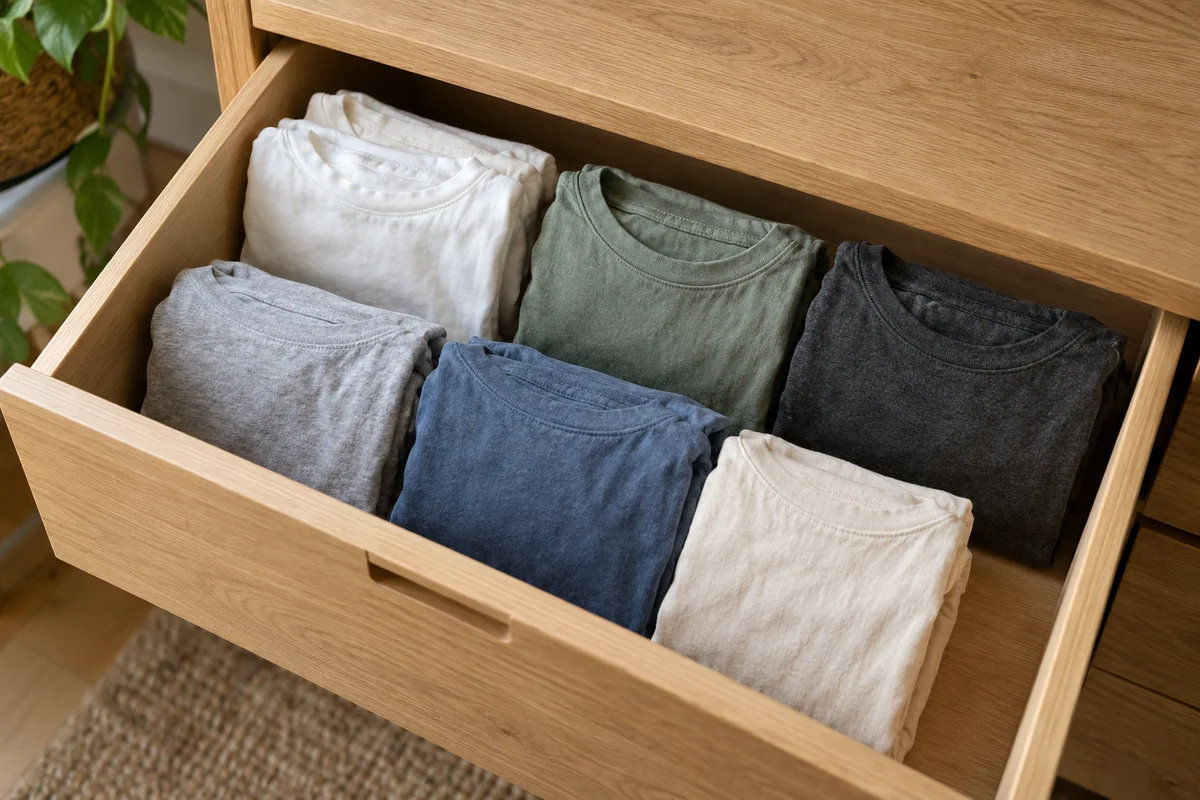
A tall horizontal stack makes the bottom shirt hard to identify. A row of upright folded shirts can reveal more choices, but only if the folded packets fit the drawer and remain easy to lift. The method is a proposed arrangement, not a promise that every fabric or garment will stand on its own.
Measure usable drawer height with the drawer fully closed, noting anything above the contents that could catch fabric. Fold one representative shirt and measure its finished packet before reorganizing the whole drawer. Garments of different sizes may need different folds.
Make one test packet
- Lay the shirt flat and smooth it without stretching it.
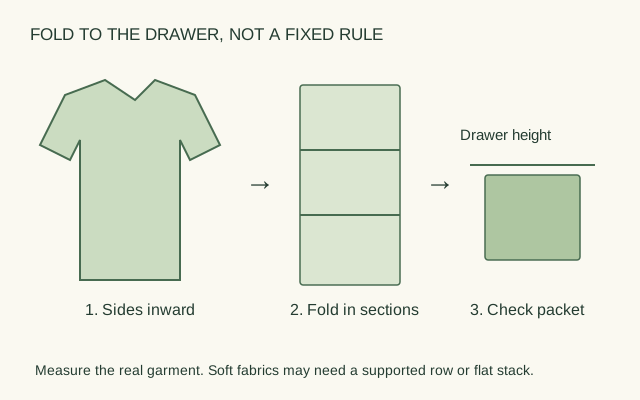
- Fold the sleeves and side panels inward to create a long rectangle.
- Fold the lower part upward in sections until the packet height fits the drawer.
- Stand it on the folded edge in a short row, supported by neighboring packets or a suitable shallow tray.
- Close and reopen the drawer gently, then retrieve the middle shirt.
The diagram describes an illustrative sequence rather than exact fold lines for all sizes. If a print, seam or bulky collar creates an uneven packet, adjust the sequence instead of forcing the garment into identical dimensions.
| Measured condition | Decision |
|---|---|
| Packet 12 cm high, usable drawer 14 cm | Trial upright storage with handling room |
| Packet 16 cm high, usable drawer 14 cm | Change the fold or choose another arrangement |
| Soft packet falls over when one shirt leaves | Use a small row support or shallow horizontal groups |
| Drawer catches the top edge | Stop; reduce packet height or use a different method |
Keep identification visible
Orient the recognizable portion consistently: collar edge, color block or a small label on the divider. Do not bury the identifying detail against the back wall. Start with one row rather than packing the entire drawer tightly; an excessively compressed row can be difficult to return shirts to.
For a hypothetical drawer 40 cm wide, three 12 cm-wide lanes use 36 cm before dividers. That remaining 4 cm must cover divider thickness and any gaps; it is not automatically a fourth lane. Measure the actual folded widths rather than relying on the example.
Use a different method when needed
Thin slippery fabrics, delicate embellishments or rarely used garments may work better lying flat in short visible stacks. A clear row is useful only if returning laundry is manageable. Check the arrangement after a normal laundry cycle: if it repeatedly collapses or requires refolding everything, reduce the row size or change the fold. Keep the result that makes selection and return easier for you.
ORIGINAL REFERENCE DIAGRAM