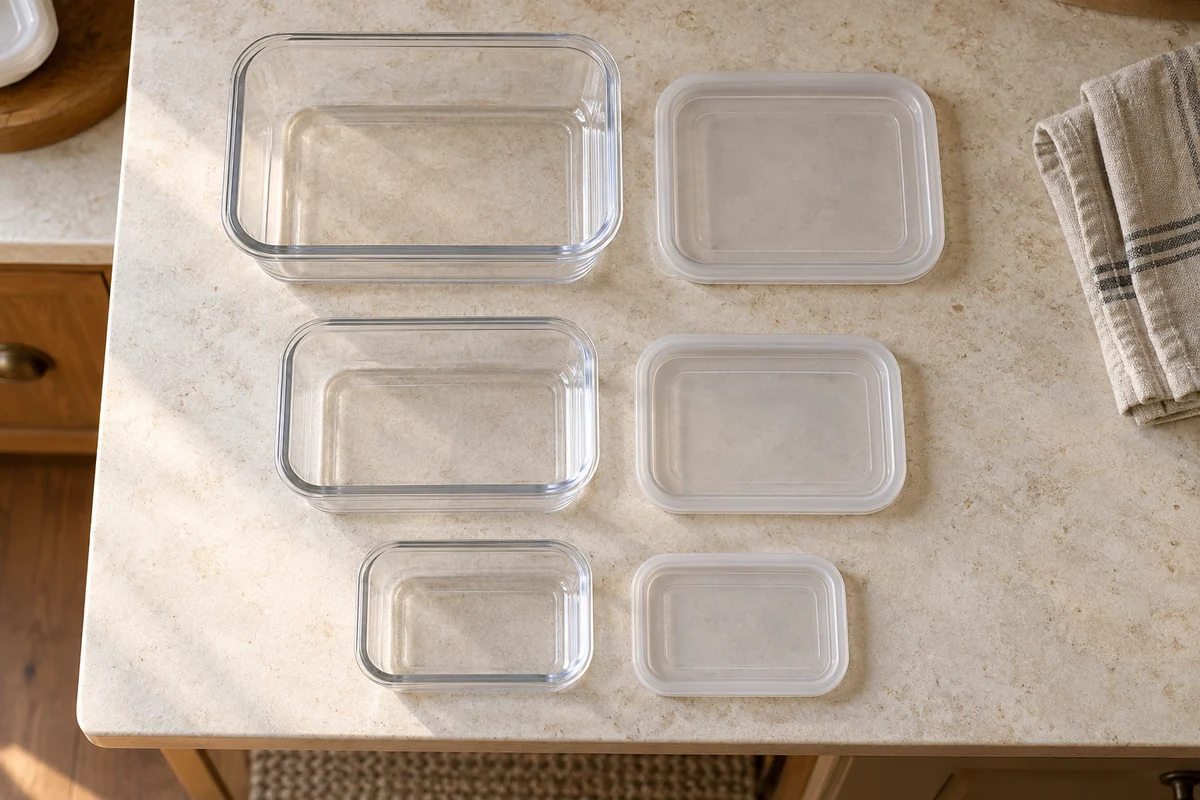
A neat stack of container bases is not useful when its matching lids are hidden in another pile. Inventory the pairs before choosing an organizer. Work with the items you actually have; similar shapes or colors do not establish that two pieces belong together.
This guide concerns matching, labeling and access. It does not assess food contact, microwave use, damaged materials or food-storage safety. Follow the manufacturer's markings and instructions for those questions.
Record the actual pairing
Lay out one base and candidate lid at a time. Confirm the intended match using the product's own identifying information where available. If the relationship is uncertain, put both pieces in a pending-check group rather than labeling them compatible.
| Set ID | Base description | Lid description | Status |
|---|---|---|---|
| FC-01 | Small rectangular base | Matching marked lid | Pair confirmed |
| FC-02 | Round base, 14 cm rim | No identified lid | Incomplete |
| FC-03 | Large rectangular base | Two similar lids | Check exact match |
This illustrative record distinguishes incomplete from uncertain. They need different next actions: locate a missing piece versus confirm the identity of a candidate.
Compare two storage routines
Storing complete sets keeps the pair together. Retrieving one set can be straightforward, but the air inside each closed container occupies shelf volume. Nesting bases can reduce their occupied footprint or stack height, while a vertical lid file makes lids visible. It adds a matching step and may require lifting several bases to reach the one needed.
For an illustrative household with two daily lunch sets and four occasional containers, keep the two daily pairs together near the front. Nest the occasional bases only if one can be removed without disrupting the entire shelf, and file their lids in the same labeled zone. This is a mixed routine chosen for frequency, not a claim that one arrangement is universally best.
Test the complete departure
Choose a base, retrieve its lid and any divider, and put the complete set back. Count the pieces that had to move. If matching still requires inspecting every lid, add a removable set identifier or keep that pair together instead. Do not write on surfaces where the product instructions prohibit it.
Put the pending-check group somewhere deliberate and give it a review event. An uncertain lid should not silently enter the confirmed inventory. When a piece leaves the household or a replacement arrives, update the pairing list before reorganizing the shelf again. The useful outcome is fewer incomplete retrievals, not the tallest possible nested stack.